Slow Letter is
a curated snapshot of Korea.
We go beyond the headlines, connect the dots, and show you what really matters — with insight and edge. We surface the stories behind the noise and bring the context you didn’t know you needed. It’s not just about what’s happening. It’s about why it matters.
This English edition combines AI-powered translation with careful human editing — using Upstage Solar-Pro-2 — and it’s still in beta mode.We’re learning as we go, and your feedback is invaluable.
[Update] Ceasefire Agreed, Contingent on Full Opening of Strait of Hormuz.
- The U.S. has accepted Pakistan’s proposed two-week ceasefire agreement.
- According to the New York Times, Donald Trump (U.S. President) emphasized, “It is contingent on Iran accepting a full, immediate, and secure opening of the Strait of Hormuz.”
- Related Link.
- Related Link.
[Update] Iran Accepts Ceasefire, Allows Strait of Hormuz Transit.
- Abbas Araghchi (Iranian Foreign Minister) posted on X, “We will guarantee safe passage through the Strait of Hormuz for two weeks, conditional on a halt to attacks against Iran.”
- The New York Times noted, “This temporary ceasefire does nothing to resolve the fundamental issues that triggered the outbreak of war on February 28.” Iran’s nuclear weapons development remains unchecked, and Tehran continues to demand war reparations.
- Related Link.
Trump’s Choice?
- According to Axios, JD Vance (U.S. Vice President) is reportedly urging Donald Trump (U.S. President) to hold back.
- Only a few, including Benjamin Netanyahu (Israeli Prime Minister) and Lindsey Graham (Republican Senator), are egging Trump on.
- Trump is cutting off his own retreat by bluffing, “We’ll blow everything to hell,” while repeatedly warning, “An entire civilization disappears tonight.”
- Shehbaz Sharif (Pakistani Prime Minister), stepping in as mediator, has proposed a two-week ceasefire.
- With about five hours left until Trump’s self-imposed deadline.
- Related Link.
- Related Link.
“A Mad Dog Thirsty for Blood.”.
- “The president is the most bloodthirsty, like a mad dog.” A Pentagon official interviewed by Axios expressed skepticism: “I doubt they’ll extend the deadline this time.”
- “Trump is a mad dog thirsty for blood—even Pete Hegseth (U.S. Defense Secretary) and Marco Rubio (U.S. Secretary of State) seem like doves in comparison.”
- Iran has proposed a deal, and the U.S. government has sent back a revised draft—but a response could take considerable time.
- Iran has completely cut off communications. Citizens are forming human shields around power plants.
“Anxious to End the War.”.
- “Trump is itching to end the war.” That’s what a White House official told a Wall Street Journal reporter.
- On March 21, he said, “If the Strait of Hormuz isn’t opened within 48 hours, we’ll destroy it completely.”
- On March 23, he extended the deadline by five days, claiming, “Productive discussions are underway.”
- On March 26, he set April 6 as the new negotiation deadline.
- On April 4, he warned, “A hellish disaster will strike within 48 hours.”
- On April 5, he cautioned, “Tuesday will be the day of power plants and bridges.”
- That D-Day is 8:00 PM on the 7th, 9:00 AM Korean time on the 8th (today).
- Will he back down again? Trump said, “Iran is delaying negotiations to avoid reaching any agreement.” The Wall Street Journal assessed, “Expectations are fading.”
- Markets are biding their time for now. The S&P 500, Dow, and Nasdaq closed at +0.08%, -0.18%, and +0.10%, respectively.
- Related Link.
- Related Link.
Trump Trapped in an Echo Chamber.
- Trump believed Iran would capitulate. John Radcliffe (CIA Director) dismissed Benjamin Netanyahu’s (Israeli Prime Minister) scenario as absurd, yet no White House aides—except JD Vance—dared challenge it. That’s the New York Times’ analysis.
- Trump’s second-term cabinet was especially stocked with sycophants. He was surrounded by people who showed superstitious faith in his destiny, intuition, and ability to create new realities.
- The New York Times assessed that JD Vance has been abandoned. Once a leading contender for the next presidency, he now faces a situation as difficult as navigating the Strait of Hormuz.
- Related Link.
- Related Link.
What Matters Now.
“Declare You Won’t Seek Re-election.”.
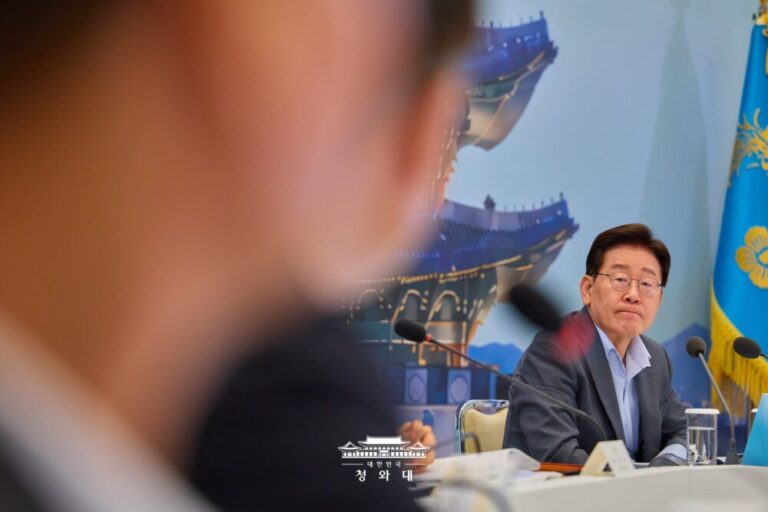
- Jang Dong-hyeok (People Power Party leader) said this to Lee Jae-myung (president) in a meeting—it was out of left field. Re-election is impossible anyway. Even with a constitutional amendment, it wouldn’t apply to the current president. Lee responded, “Doesn’t the People Power Party hold enough seats to block constitutional amendments? Why worry?”
- There was a minor clash over the supplementary budget. When Jang said, “Handing out cash could worsen inflation and exchange rates—it might trade short-term joy for long-term pain,” Lee countered, “‘Handing out cash’ is an overstatement. The National Assembly can add necessary items or cut what’s deemed unnecessary.”
- The overall atmosphere was cordial. They even joked, “Didn’t the two of you shake hands?” as they arranged a handshake between Jeong Cheong-rae (Democratic Party leader) and Jang.
- When Jang argued, “4.9 billion won for TBS funding doesn’t fit the supplementary budget’s purpose,” Jeong agreed, “We’ve agreed it doesn’t align with the budget’s nature—we won’t proceed.”
- When Song Eun-seok (People Power Party floor leader) asked Lee, “Why not just face trial?” Lee didn’t respond.
- Related Link.
- Related Link.
Democratic Party’s Gyeonggi Governor Candidate: Cho Kuk.
- Cho Kuk (Democratic Party lawmaker) secured a majority in the primary election decided by 100% party-member voting. The 10% bonus points for female candidates also played a significant role.
- The People Power Party has yet to even set a primary schedule. Only Yang Hyang-ja (People Power Party Supreme Council member) and Ham Jin-kyu (former Korea Expressway Corporation CEO) have applied for nominations.
“Rising by Half a Billion Dollars Daily.”.
- Analysis from the Center for Strategic and International Studies (CSIS). Within five weeks of U.S. strikes against Iran, losses ranged between $22.3 billion and $31 billion.
- Official statistics remain undisclosed, but it’s clear U.S. overwhelming firepower has significantly diminished.
- The attack on Saudi Arabia’s radar base also inflicted massive losses. Each THAAD unit costs $490 million, takes three years to rebuild—and none remain in stock. They’ve gone so far as relocating THAAD units stationed in South Korea.
- Related Link.
“Who Else Hasn’t Helped Us? South Korea.”.
- “There are 50,000 U.S. troops in Japan and 45,000 in South Korea protecting them. They’re risking danger right next to Kim Jong-un, who has nuclear weapons. Yet they received no help at all.”
- The numbers are wrong to begin with. There are approximately 28,500 U.S. troops stationed in South Korea.
Ha Jung-woo to Fill Jeon Jae-su’s Vacancy.
- If Jeon Jae-su (Democratic Party lawmaker) runs for Busan mayor, the Busan Buk-gap seat will open. Ha Jung-woo (Chief of AI Future Planning at the Blue House) is likely to be deployed. He has expressed his intent to run, pending only the president’s approval.
- Lee Jae-myung calls him “my HaGPT,” and he’s been nicknamed the “AI King’s Man” (the man who lives with the king).
- In an editorial, Chosun Ilbo expressed strong disapproval: “They’re pulling the AI policy commander into an election just to secure one National Assembly seat.”
- Related Link.
Cho Kuk’s Six Mountains, One Villa Dilemma.
- Speculation also arises that Cho Kuk (leader of the Cho Kuk Innovation Party) will run. He is pondering among six mountainous districts and one villa-like constituency.
- Busan (Buk-gap), Ulsan (Nam-gu Gap), Ansan (Gap), Asan, Gunsan, Gwangju Gwangsan, and Pyeongtaek.
- Polling in Gunsan showed him trailing significantly behind Kim Eui-gyeom (former Saemangeum Development Agency chief).
- Ansan and Pyeongtaek are being eyed by Kim Yong (former deputy director of the Democratic Research Institute). Ansan also sees mentions of Kim Nam-guk (Democratic Party spokesperson) and Jeon Hae-cheol (former Democratic Party lawmaker). Rumors claim the Blue House endorsed Jeon Eun-su (Blue House spokesperson) for Ulsan.
- None are easy picks. Electoral alliances with the Democratic Party remain the wildcard.
Deep Dive.
Samsung Electronics’ Earnings Surprise.
- Samsung Electronics’ first-quarter operating profit reached 57.2 trillion won—an earnings surprise far exceeding market expectations.
- Revenue was 133.1 trillion won. Both revenue and operating profit surged 42% and 185% respectively from the previous quarter.
- This is a first in Korean corporate history, but more importantly, it signals the start of a new era. The semiconductor supercycle has just begun, and expectations grow that it could be larger than previously anticipated.
- Looking solely at the semiconductor division: revenue of 50.9 trillion won, operating profit of 36.5 trillion won, and an operating margin of 72% (per Mirae Asset Securities estimates). This is an extraordinary margin, rare not only in Korea but globally.
- It also underscores the heavy investment burden and deflation risks in the global AI industry.
- Meritz Securities forecasts that Samsung’s earnings peak will occur between this year’s fourth quarter and next year’s second quarter—suggesting performance higher than Q1 will continue until late this year.
Global Operating Profit Leadership Within Reach.
- Analyses also suggest the possibility of ranking first globally in operating profit. KB Securities forecasts Samsung Electronics’ 2024 operating profit at 327 trillion won and 2025 at 488 trillion won—projecting second place behind Nvidia this year, then surpassing it next year.
- 327 trillion won equates to 900 billion won per day.
- Son Hyun-deok (Chosun Ilbo columnist) remarked, “Every company aims to become a market-dominating player,” adding, “Monopoly changes one’s status.”
- The Financial Times highlighted, “The Middle East war has not affected semiconductor production or prices.” Samsung is expanding long-term contracts—a sign they expect supply shortages to persist for 3–5 years.
- Related Link.
- Related Link.
Another Take.
Working Earns 1.95M, Unemployed Earns 1.98M.
- They plan to address the unemployment benefit reversal phenomenon, where the minimum wage net amount is lower than the unemployment benefit floor.
- Yoon Dong-yeol (Konkuk University professor) proposed, “There’s a need to reduce the floor amount while considering extending payment periods.”
- The ease of repeated claims is also problematic. Japan and Germany require at least 12 months of employment insurance payments within 36 months before retirement to qualify for unemployment benefits, whereas South Korea only requires 6 months within 18 months.
- According to JoongAng Ilbo, the unemployment benefit account reserve will reach -1.4 trillion won next year. By 2035, this deficit is projected to grow to 29 trillion won.
- Related Link.
Seoul Gasoline Prices Surpass 2,000 Won per Liter.
- National average is 1,968 won. The all-time high was in June 2022, at 2,213 won.
- According to the Ministry of Trade, Industry and Energy, refinery utilization rates are around 90%, with naphtha supply at 80–90%. Yang Gi-wook (Director-General of Industrial Resource Security, Ministry of Trade, Industry and Energy) noted, “The question is whether supply can continue in May.”
- Tax-free fuel for fishermen, priced at 200 liters, jumped from 160,000 won in February to 180,000 won in March, then to 280,000 won in April.
- Delivery drivers are also hit hard. Fuel costs have risen by an average of 60,000 won per month. To earn as much as before, they say they must work 12 hours a day.
The Fix.
Why Shouldn’t a Failing Company Sold Cheaply Be Transferred to Employees?
- Handing it over to employees could be a turning point for revival rather than sacrificing it to restructuring.
- KECC (Korea Engineering & Consulting Co.) employees bought the company a decade ago. When Hanjin Heavy Industries & Holdings, the major shareholder, tried to sell it, employees pooled funds and took loans to acquire shares.
- Kim Young-soo (KECC CEO, former union head) emphasized three key factors for employee-led acquisitions:
- First, employees must be persuaded well. 50 million won is a significant sum. 830 employees contributed up to 50 million won each, raising 38.5 billion won, and secured 14.5 billion won in loans to acquire 52% ownership.
- Second, securing loans is not easy. A bank reviewer once said, “What if 900 people lie down in front of the bank at once when problems arise?”
- Third, social perception is a hurdle. There’s a long-standing bias that companies without owners fail, and business also suffered.
- At KECC, everyone casts one vote. Each department selects directors based on contributors. A 40-member board monitors and checks management decisions. Contrary to concerns, it turned profitable within three years, and the workforce grew from 1,187 to 1,933.
- It follows the 3-3-3 principle: 30% of operating profit goes to salary increases, 30% to performance rewards for contributors, and the remaining 30% is retained as investment funds.
- Kim said, “There will be people who dream of blocking owner risks with communal spirit and pursuing corporate growth and shareholder interests,” adding, “I hope more companies like ours emerge in Korean capitalism.”
- Song Tae-kyung (Secretary-General of the People’s Livelihood Solidarity) argued, “The system should be changed so that major shareholders benefit more from selling to employees than to the market,” suggesting, “Reducing capital gains taxes and providing convenience when selling shares to employees would suffice.”
- Related Link.
Will We Face an Oil War Every Year?
- Russia is reaping an additional $150 million daily thanks to the war. The U.S., the world’s top oil producer, is projected to secure $60 billion in profits.
- Petrostates are nations that benefit from rising fossil fuel prices. Electrostates refer to countries seeking to break free from fossil fuel dependence.
- The U.S. and Russia aim to preserve petrostate dominance, while China and India rapidly transition toward becoming electrostates.
- Though still the world’s largest carbon emitter, China also leads in renewable energy production—its clean energy investments exceed $1 trillion. India announced plans to generate 60% of its electricity from low-carbon sources by 2035.
- The Guardian warns that the current energy shock will not be a temporary phenomenon. At current rates, global temperatures could rise over 2 degrees Celsius above pre-industrial levels within 20 years. “The economic damage from climate collapse,” it cautions, “will rival the annual toll of an oil war.”
- “The top 10 emitting nations account for two-thirds of global emissions. Their choices will determine humanity’s future. Lessons must be drawn from this catastrophic conflict.”
- Related Link.
One Person Received 265 Shockwave Therapy Sessions in a Single Year.
- Over eight years, 2,086 sessions were claimed, yielding 281.73 million won in actual expense insurance payouts.
- Insurance payouts for shockwave therapy from seven non-life insurers reached 512.3 billion won last year.
- Prices vary wildly, from 10,000 won to 450,000 won per session.
- An industry insider interviewed by Maeil Business Newspaper stated, “Cases where non-covered cosmetic procedures are disguised as shockwave therapy for insurance claims are frequent.”
- Another analysis suggests, “As manual therapy was incorporated into managed care, a balloon effect has inflated excessive shockwave treatments.”
- The government is preparing to launch a fifth-generation actual expense insurance plan, lowering premiums by about 30% while increasing patient co-payments from 30% to 50% for non-severe treatments.
- Related Link.
Free Public Transit for Seniors Remains Unrestricted.
- Hong Ik-pyo (Senior Presidential Secretary for Political Affairs) told the Korean Senior Citizens Association during a meeting, “There is no plan to restrict free transit.”
- A proposal to reduce congestion during rush hours was scrapped. According to Seoul Metro, seniors accounted for 9.7% of riders from 7–8 a.m. and 7.9% from 8–9 a.m.
POSCO Directly Hires 7,000 Subcontract Workers.
- This is the effect of the Yellow Envelope Law.
- POSCO has decided to directly employ all 7,000 workers from subcontractors at its Pohang and Gwangyang steelworks production sites. “We aim to eradicate the outsourcing of risk and fundamentally innovate our safety management system,” it announced.
Fewer Than 30,000 Rental Listings in Seoul.
- Last January saw 52,000 listings; this January had 44,000.
- In Seongbuk-gu, listings dropped from 1,931 in April last year to 274 yesterday.
- The rise in actual residents—due to the collapse of “gap” investment—is a key factor.
- According to real estate data firm Asil, Seoul apartment jeonse prices rose 1.6% cumulatively this year.
- Chosun Ilbo analyzed new jeonse contracts: Gangnam and Seocho saw 7.5% and 3.8% increases, while Seongbuk and Dobong surged 17.9% and 15.0%.
- This means lower-income households face disproportionately higher housing costs.
- Related Link.
- Related Link.
“To Your Korean Mother.”.
- This is the title of a book written by Kristin Molvik Botnanmark (Professor at Oslo Metropolitan University), who has an adopted Korean son and daughter.
- She traveled to Korea seeking answers to her son’s questions and discovered the realities of the adoption industry, stating, “I couldn’t shake the thought that I had participated in a massive industry that bought and sold children.”
- She hadn’t specifically sought Korean children—only that Korea made adoption swift and easy. Botnanmark noted, “It began with good intentions but became an industry.”
- Botnanmark paid 62,000 kroner (9.63 million won) to the adoption agency, described as administrative fees.
- In Korea, care and welfare remained privatized, allowing private agencies to dominate overseas adoption. Official records alone count 170,000 children—many labeled as “abandoned,” with widespread distortion and manipulation.
- The government belatedly began state-led reviews and management of overseas adoptions last year, with a full suspension until 2029.
- Botnanmark criticized, “The problem was systematizing adoption while ignoring each child’s unique circumstances,” adding, “For adoption to function ideally, birth and adoptive families must follow open, transparent procedures.”
- Related Link.
- Related Link.
- Related Link.
ICYMI.
Jeju Olle: 4,500 Finish the Trail Annually.
- Seo Myung-sook (Jeju Olle Director), who created the Olle Trail, has passed away. She was 68.
- She visited a hospital 20 days ago complaining of side pain; it was terminal lung cancer with pleural effusion, leaving no room for treatment.
- She reportedly suffered burnout during her tenure as a journalist for Shinsa Journal and editor-in-chief of OhmyNews.
- After walking the Camino de Santiago in 2005, she founded the Olle Trail.
- The Camino spans 800 km; Jeju Olle is 437 km. Over 13 million people have walked it at least once.
- JoongAng Ilbo assessed, “More important than Jeju Olle’s achievements is the human pace it awakened.”
- Related Link.
Worth Reading.
A Person with the Courage to Stop Remains in History.
- Koo Ki-yeon (Professor at Seoul National University) emphasized, “Both Iran and the U.S. must come to the negotiating table.”
- Mohammad Javad Zarif (Former Iranian Foreign Minister) wrote in Foreign Affairs, “Iran’s fight against the U.S. and Israel may provide psychological satisfaction, but it ultimately only results in the destruction of civilian lives and infrastructure.”
- Koo Ki-yeon pointed out, “War is not won by the strong but by those with the courage to stop—those who remain in history.” “And the end must be a direction where time can flow again in the streets of a generation that has been burned,” she added.
- Related Link.
Xi’s Tripartite Strategy for Global Dominance.
- China holds hands with Russia while playing coy with Europe.
- Last December, Emmanuel Macron (French President) visited Beijing. In February, Wang Yi (Chinese Foreign Minister) traveled to Germany. In between, leaders from Germany, the UK, Spain, Ireland, and Finland also visited.
- China is pulling the Global South closer while exploiting subtle tensions between Europe and the U.S.
- Park Min-hee (Senior Reporter at Hankyoreh) analyzed, “Security-wise, it’s ‘U.S.-China-Russia’; economically and technologically, it’s ‘U.S.-China-Europe’—a tripartite division of the world.” She added, “From Europe’s perspective, a predictable ‘emperor’ might be preferable to an unstable ‘villain.’”
- Related Link.
“Trump Is Just That Way” Is the Wrong Response.
- That familiarity is exactly what norm-breaker Trump aims to exploit.
- Ko Myeong-seop (author) warned, “The quality of a community is determined by the level of its language,” adding, “The corruption of language invites the corruption of a nation.”
- Lee Bong-hyun (research fellow at the Hankyoreh Economic and Social Research Institute) noted, “A society numb to corrupted language fails to protect the goodwill of those striving to be better.”