Slow Letter is
a curated snapshot of Korea.
We go beyond the headlines, connect the dots, and show you what really matters — with insight and edge. We surface the stories behind the noise and bring the context you didn’t know you needed. It’s not just about what’s happening. It’s about why it matters.
This English edition combines AI-powered translation with careful human editing — using Upstage Solar-Pro-2 — and it’s still in beta mode.We’re learning as we go, and your feedback is invaluable.
Why Did Trump Do It?
- Raising tariffs to 25% was likely not an empty threat but pressure to keep investment promises.
- Japan, which pledged $550 billion in U.S. investment, bypassed parliamentary approval and immediately formed a negotiation committee to scout investment targets.
- Unlike Japan, South Korea made bill submission a condition for the investment agreement’s entry into force. Though the bill was proposed last November, it remains under discussion in the National Assembly. It’s not intentional obstruction, but the talks have indeed stalled.
- Bloomberg’s report that “South Korea’s investment may be delayed” could have provoked Trump. It’s safe to assume he was also briefed on Koo Yoon-cheol’s (Minister of Economy and Finance) remarks to Reuters that “execution in the first half is difficult.”
- The currency excuse might have been a pretext to delay until a federal court ruling—one that could deem tariff hikes without congressional approval illegal.
- It was also later revealed that the U.S. requested Seoul on the 13th to “implement follow-up measures.”
- Related Link.
- Related Link.
- Related Link.
South Korea and the U.S.: A Tale of Two Visions.
- The fact sheet signed last November contained no timeline for when investments should begin.
- The special law also lacks binding clauses and was not explicitly demanded by the U.S.
- While the South Korean government loosely interpreted the agreement as requiring action only before Trump’s term ends, Trump is fuming over the lack of immediate payment.
- If investments are inevitable, there is no way to avoid or delay them indefinitely. Though a federal court could rule that reciprocal tariffs without congressional approval are illegal, Trump might impose tariffs through alternative channels.
- From Trump’s perspective, he may have wanted to set an example for the EU by pressuring South Korea—but the issue is unlikely to resolve before actual payments are made.
U.S. Investment: Does It Need Parliamentary Approval?
- The South Korean government has decided to establish the Korea-U.S. Strategic Investment Corporation with 3 trillion won in capital and form an operational committee, chaired by the Minister of Economy and Finance.
- The Democratic Party insists on a special law, while the People Power Party demands ratification procedures, leaving little room for compromise. Five bills have been proposed, differing mainly in the extent of parliamentary involvement.
- While the U.S. government decides investment targets and South Korea can only consult, Park Sung-hoon (People Power Party lawmaker)’s bill requires parliamentary reporting and approval for both proposals and implementation—a non-starter for the Democratic Party. Jin Sung-jun (Democratic Party lawmaker)’s bill also mandates prior parliamentary consent. Ahn Do-gil (Democratic Party lawmaker)’s bill requires reporting for investments over $1 billion and approval for those exceeding $3 billion. Kim Byung-ki (Independent lawmaker)’s bill only requires post-facto reporting.
- None of the five bills have even reached subcommittee review.
- While the People Power Party is being obstinate, the Democratic Party has also shown little urgency in passing the special law. Both sides recognize the national interest at stake. The Democratic Party is reluctant to force a vote, and the People Power Party may soften its stance on mandatory ratification.
- Related Link.
- Related Link.
- Related Link.
KOSPI Soars Despite Trump’s Threats.
- Closed above 5,000 for the first time. Up 2.7% to 5,084.95.
- Foreign and institutional investors bought; individuals sold.
- Samsung Electronics and SK Hynix led gains, rising 5% and 9%, respectively. Citigroup raised SK Hynix’s target price to 1.4 million won.
- Hyundai Motor and Kia, facing tariff shocks, held relatively steady at -0.5% and -1.1%, respectively.
What Matters Now.
How Much Will Hyundai Motor Lose?
- Hyundai’s tariff burden would be 3.4 trillion won at 15%. At 25%, it rises to 5.7 trillion won.
- Projections suggest operating profits could shrink by 21–23%. Some analyses warn of up to 11 trillion won in damage.
- Many had forecasted Hyundai catching up to GM and solidifying its No. 2 position behind Toyota, but tariff shocks could delay that.
- Adding Tesla and BYD (electric vehicle makers), Hyundai ranks fourth by market capitalization.
Kim Min-seok’s Hotline: A Premature Brag.
- It’s awkward now. He boasted about meeting JD Vance (U.S. Vice President) and receiving a direct line to the vice president’s office. “There were delays in implementing agreed-upon outcomes like the joint fact sheet after the Korea-U.S. tariff negotiations, so we needed to follow up,” he said.
- Coincidentally, the day Kim Min-seok (Prime Minister) returned from the U.S., Trump dropped a bombshell. Did Vance not know?
- The People Power Party issued a statement: “Did the hotline the Prime Minister bragged about go dead within a day?”
- Related Link.
- Related Link.
Will Trump TACO Again?
- Trump Always Chickens Out. It means “Trump always gets cold feet and backs down.”
- Last year, during the tariff war declaration, he changed his stance 28 times between April and July. Recently, he threatened to impose 10% tariffs on eight European countries over the Greenland dispute but stepped back.
- Trump’s approval rating has dropped to 38%. Public backlash is intense following the Minneapolis, Minnesota incident. He replaced the immigration enforcement chief and promised a fair investigation.
Deep Dive.
Kim Keon-hee’s First Sentencing Today.
- Three major allegations: Deutsche Motors stock manipulation, Myeong Tae-gyun’s poll rigging, and receiving funds from the Unification Church.
- Live broadcast begins at 2:10 PM.
- The alleged illicit gains are 810 million won, 274.4 million won, and 80 million won, respectively.
- The special prosecution requested 11 years for violating the Capital Markets Act and 4 years for violating the Political Funds Act.
- Kim Keon-hee (First Lady) claims she was unaware of the stock manipulation and that the polls were unilaterally sent by Myeong Tae-gyun. She argued that items like the necklace from the Unification Church were merely ceremonial gifts.
“You Don’t Care.”.
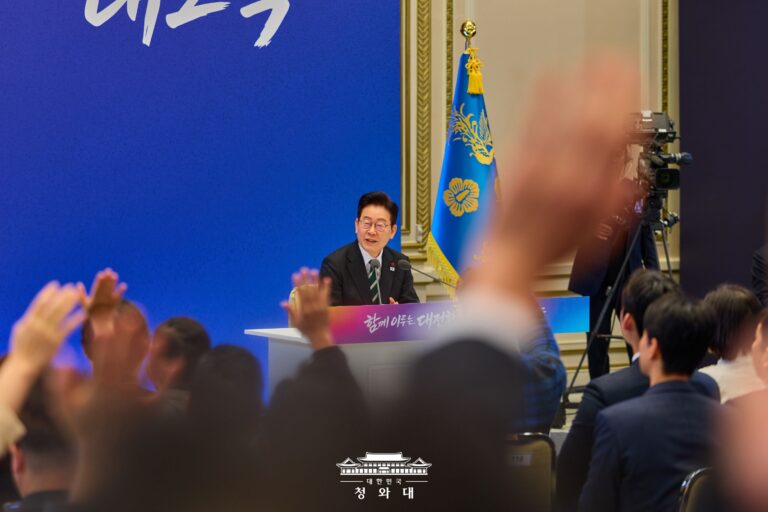
- Lee Jae-myung (President) said this while reprimanding Lim Gwang-hyun (National Tax Service Commissioner).
- Lim Gwang-hyun stated, “The National Tax Service can only collect national taxes, and to entrust collection of arrears, the National Debt Management Act must be amended.”
- When Lee Jae-myung instructed, “Since legislation is slow, why not dispatch personnel under ministry names or implement joint management even before that?” Lim Gwang-hyun retorted, “Amending the law might be faster.”
- Lee Jae-myung remarked, “The National Assembly is slow—who knows when it’ll happen?” and urged, “Don’t delay. Take some emergency measures.”
High Likelihood of Han Dong-hoon’s Expulsion.
- Jang Dong-hyeok (People Power Party leader) may attend the Supreme Council meeting tomorrow to process the disciplinary action against Han Dong-hoon (former People Power Party leader).
- Han Dong-hoon has not requested a retrial nor visited Jang Dong-hyeok’s hunger strike site. Discontent within the party leadership is boiling over.
- Han Dong-hoon strongly criticized the disciplinary decision against Kim Jong-hyeok (former People Power Party Supreme Council member) as “not democracy but North Korean leader theory” and “pseudo-democracy.” His stance implies no intention to apologize and willingness to accept punishment.
Whose Fight Is This?
- Approval ratings are plummeting, yet Jang Dong-hyeok is clashing with Han Dong-hoon. The Korea Daily editorial noted, “They must ask themselves: whose fight is this, anyway?”
- The JoongAng Ilbo criticized the disciplinary action against Kim Jong-hyeok, calling the Ethics Committee’s decision—which effectively declared the party leader a “sacred entity”—“not just sophistry but unconstitutional.” The Kyunghyang Shinmun also denounced it as “totalitarian behavior that negates party democracy.”
- The People Power Party Ethics Committee justified the disciplinary action by stating, “The party leader is not merely an individual but the collective will of all members.” The Chosun Ilbo editorial condemned this as “something unseen even during the authoritarian 1970s.”
- Related Link.
- Related Link.
- Related Link.
- Related Link.
People Power Party Without Han Dong-hoon?
- “Jang Dong-hyeok (People Power Party leader) risked his life on a hunger strike but failed to cut out a single rotten radish root.”
- A table was set with Lee Hye-hoon, but he couldn’t take a single bite before clearing the table. The only exit strategy he managed to grasp was Park Geun-hye (former president).
- To Hwang Su-jeong (Seoul Shinmun editorial director), “Han Dong-hoon is at least proof that the People Power Party isn’t a seditious party.” There may be quite a few People Power Party supporters who think like Hwang Su-jeong. Hwang Su-jeong pointed out, “Rebuilding conservatism in a distant land is like putting a horseshoe on a development project for someone who removes the last piece of evidence with their own hands.”
- Related Link.
Another Take.
Travel Bans for Investigations: 9,018 Cases in One Year.
- Many discover they are banned from leaving the country only after arriving at the airport and returning home.
- Prosecutors and police omit prior notification in 51% and 33% of cases, respectively.
- Kim Hoo-gon (former Seoul High Prosecutors’ Office chief) noted, “Since travel bans effectively restrict freedom akin to arrest or detention, stronger judicial oversight is essential.”
- Related Link.
Hankyoreh Doubts Lee Jae-myung’s Will to Prosecute Reform.
- Hankyoreh has consistently demanded aggressive prosecution reform. Lee Sung-jung (Hankyoreh columnist) noted, “Lee Jae-myung’s (President) remarks were sufficient to raise concerns that prosecution logic might be seeping in.”
- This refers to his statement during the New Year press conference: “Since the Constitution mentions the Prosecutor General, it’s correct to call the head of the prosecution office the Prosecutor General.”
- Lee Sung-jung added, “It’s worrying how Roh Man-seok’s (former acting Prosecutor General) baseless claims could have influenced the President.”
- Even when Bong Wook (Blue House Senior Secretary for Civil Affairs) argued that the Central Investigations Office should be designed as a dual-system led by legal professionals, there were doubts about whether a former prosecutor could effectively drive reform.
- Lee Sung-jung emphasized, “We must clear the rigged table set by the prosecution and advance discussions on democratic control mechanisms for the prosecution office.”
- Related Link.
The Fix.
Is a Doctor’s Apology an Admission of Guilt? Preventing Medical Errors Through Systemic Reform.
- Kang Hee-kyung (Seoul National University College of Medicine professor) proposed, “Let’s establish an independent patient safety investigation agency.” The focus should be on how to improve systems rather than assigning blame.
- Annually, 700–800 criminal complaints result in 40–50 convictions. Civil lawsuits number 800–900, with medical staff held liable in about 30% of cases.
- Kang Hee-kyung attributes this to “insufficient explanation.” “Medical outcomes aren’t always satisfactory, but the current system lacks resources to adequately explain unfortunate situations. Due to the misconception that ‘an apology equals an admission of guilt,’ there are many cases where proper communication or consolation fails,” she explained.
- A patient safety net fund is also necessary. The proposal aims to swiftly compensate patients and reduce doctors’ burdens before determining fault.
- Related Link.
“Because They’re Paid a Little.”.
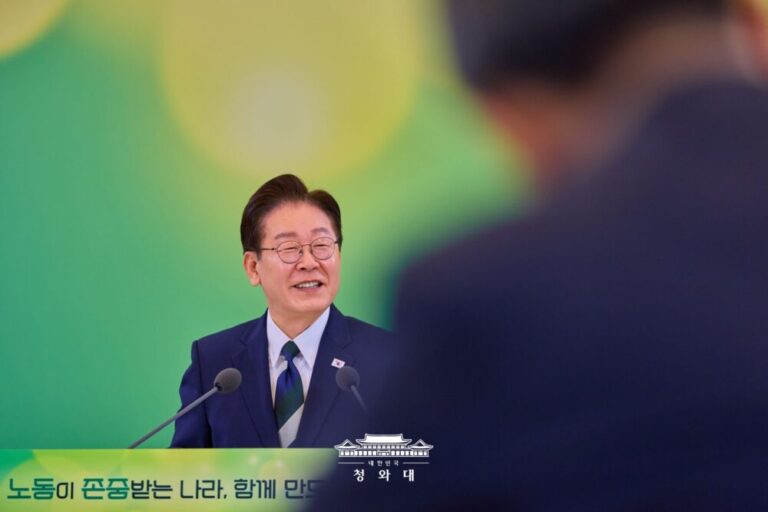
- Lee Jae-myung (President) said this at a town hall meeting in Ulsan.
- “Isn’t it strange that we have world-class competitiveness, making trillions in profit, by hiring foreign workers for 2.2 million won? The labor intensity is high, but since we only pay minimum wage, we can’t find domestic workers and instead fill positions with foreign labor. We need to reconsider whether fostering and supporting the shipbuilding industry this way is desirable.”
- Kim Doo-gyeom (Ulsan Mayor) said, “When shipyard subcontractors recruit workers, only 56% are filled—44% remain unfilled.”
- Lee Jae-myung and Kim Doo-gyeom were misaligned. The issue is the regional visa system. Kim Doo-gyeom is requesting permission to bring in more foreign workers, but Lee Jae-myung countered, “Is the shipbuilding industry collapsing because of labor costs?”
- Kim Doo-gyeom argued, “China occupies 70% of the shipbuilding market with labor costs half of Korea’s, and the Korean shipbuilding industry has become a shunned job sector. If we can’t even secure foreign workers, we can’t maintain competitiveness.”
- The Ulsan branch of the Progressive Party issued a statement: “It’s not that there are no people, but that there are no jobs with proper treatment.”
- Related Link.
- Related Link.
Presidential Remark Halts Public Institution Commuter Buses.
- Relocating public institutions to regional areas only to have employees return to Seoul every weekend on chartered buses.
- Lee Jae-myung (President) pointed out, “This way, the relocation of public institutions has no effect,” prompting the Ministry of Land, Infrastructure and Transport to issue a directive halting chartered commuter bus operations.
- Criticism arises that this is rigid bureaucratic overreach, as many employees commute due to dual-income households or children’s education.
- According to the Ministry of Land, Infrastructure and Transport, the solo relocation rate is 51% in Jincheon-Eumseong, 46% in Gimcheon, and 31% in Wonju.
- Lee Chang-mu (Hanyang University professor) noted, “Eliminating commuter buses won’t lead many employees to move to regional innovation cities.”
- Related Link.
Did Relocating Public Institutions Revive the Regions?
- 153 institutions were relocated over 16 years. The Jincheon-Eumseong Innovation City lacks even pediatric or ophthalmology clinics, let alone postpartum care centers.
- Choi Joon-young (Yulchon Senior Advisor) pointed out, “This is far from the original goal of creating hubs for innovation and growth,” adding, “If public institutions are treated as spoils of war and scattered arbitrarily, regional revival will remain elusive.”
- Where KEPCO left, an international exchange complex rose; where the Korea Expressway Corporation departed, Pangyo Techno Valley emerged. While Seoul and Gyeonggi—where public enterprises were relocated from—created new opportunities, regions still cling to dividing spoils.
- Choi Joon-young emphasized, “We must confront the irony that the spaces left by public institutions have become Korea’s premier innovation hubs.” The implication is that regions should seek agglomeration effects rather than mere dispersal.
- Related Link.
ICYMI.
China Relocates West Sea Structure.
- One of the three structures installed in the PMZ (Provisional Measures Zone) has been moved outside the zone.
- The Chinese government has claimed it was a salmon aquaculture facility, but concerns persisted that it could be repurposed for military use. Geng Shuang (Chinese Foreign Ministry spokesperson) stated, “It was an autonomous decision by the company,” but emphasized, “China and South Korea have promoted mutually beneficial cooperation.” This suggests diplomatic considerations were involved.
Digital Twin Earth.
- NVIDIA unveiled a digital twin project replicating Earth’s environment in a virtual space.
- NVIDIA’s ‘Earth-2’ reduces computation time by 90% compared to existing models.
- Unlike supercomputer-based weather forecasting, it increases prediction speed and reduces costs through AI learning.
- Jensen Huang (NVIDIA CEO) called it “the culmination of every technology we’ve ever invented” and added, “I can’t imagine a more monumental or consequential application.”
- Related Link.
Worth Reading.
Advice from Chosun Ilbo and JoongAng Ilbo.
- Park Hyo-jong (Seoul National University professor) argued that conservatives are guilty of “not nurturing.” The progressive camp raised the 3040 generation through the Roh Moo-hyun and Moon Jae-in administrations—a path from aides and local councils to metropolitan governments and the National Assembly. What about conservatives? They’ve protected vested interests by handpicking elites and prominent figures.
- Choi Hoon (JoongAng Ilbo editor-in-chief) assessed this as a “stark contrast between ‘bottom-up’ and ‘top-down.’”
- The advice: “Nurturing and giving is conservatism,” and “that’s the weapon to defeat progressive politics.”
- Jeong Woo-sang (Chosun Ilbo editorial writer) offered similar counsel. Jeong Cheong-rae (Democratic Party leader) and Han Byung-do (Democratic Party floor leader), who learned politics through student activism, are “politicians equipped with political AI.” What about Jang Dong-hyeok? He entered politics after serving as a judge, so he’s only been in the field for about five years. Yoon Suk-yeol, who became president after serving as prosecutor general, was equally clueless about politics.
- The People Power Party granted nominations to those close to the president or who seemed immediately vote-worthy.
- Jeong Woo-sang pointed out, “The People Power Party’s ‘side hustle politics’—aimed at countering the Democratic Party’s ‘career politics’—is not driving innovation or collaboration but regression and division.”
- Related Link.
- Related Link.
Tax Breaks for Directors: A Tempting Bait.
- The Ministry of Economy and Finance proposed an RIA (Domestic Market Repatriation Account). It’s a product that exempts capital gains tax if you sell overseas stocks and buy domestic ones.
- Woo Suk-jin (Myongji University professor) emphasized, “The primary goal of tax policy is to minimize resource allocation distortions while securing tax revenue stably.”
- The problem with RIA is: first, its effects are delayed and uncertain. Second, it undermines tax neutrality and breeds distrust. Third, it’s unclear who it’s supposed to support in the first place. Fourth, these invisible budgets are hard to track in terms of scale.
- Woo Suk-jin stressed, “Rather than prioritizing tax systems, coordination is needed to align regulations, budgets, and industrial policies as a package. Self-restraint—boldly phasing out ineffective tax breaks—is essential.”
- Related Link.
Betrayal’s Unending Hell.
- Yoo Seung-min, Kim Moo-sung, Joo Ho-young, Kim Sung-tae, Oh Se-hoon, Lee Jun-seok, Na Kyung-won, Won Hee-ryong, Hong Joon-pyo, Ahn Cheol-soo, Han Dong-hoon, Jang Dong-hyeok.
- These are politicians who have at least once been labeled “betrayers.”
- When times are good, there’s no need to fight. When approval ratings drop and the pie shrinks, they turn on internal enemies. Kim Joon-il (political commentator) analyzed, “The very purpose of politics has become purging betrayers.”
- “Once a betrayer is purged, they search for a new one—like a virus constantly seeking new hosts. Politicians tremble at the thought of contracting the betrayal virus. To avoid being labeled a betrayer, they accuse others of betrayal.”
- Even as approval ratings plummet, Jang Dong-hyeok fights Han Dong-hoon for this reason. The analysis: “There seems no escape from this ‘unending hell of betrayal.’”
- Related Link.
What Did Han Duck-soo Do After Yoon Suk-yeol’s Impeachment?
- Han Duck-soo (then-Prime Minister) proposed to Yoon Suk-yeol that a State Council meeting should be convened. He did not stop Yoon, who was on his way to declare martial law.
- The crimes Han Duck-soo committed did not end there. His refusal to appoint a Constitutional Court judge may have been intended to block Yoon Suk-yeol’s removal. With three of the nine judge seats vacant, even one dissenting vote would have led to dismissal.
- After Yoon Suk-yeol’s removal, Han Duck-soo abandoned his role as acting president and attempted to run in the presidential election. He even demanded a merger with Kim Moon-soo (former Labor Minister), who had already been selected as the candidate.
- Yoon Wan-jun (Donga Ilbo editorial writer) pointed out, “Han Duck-soo’s six months of actions raise suspicions that beyond mere inaction in failing to prevent martial law, he may have had ulterior motives to reverse its failure.”
- “Had things gone his way, the failed martial law might not have ended as just a failure,” the commentary suggested.
- Related Link.
“What Are You Thinking? Just Do It.”.
- Kim Yuna (then-figure skater) said this when asked what she thinks about while stretching.
- There are times when the ability to reset emotions and maintain distance is necessary.
- Haji Hyun (Konkuk University professor) advised, “Our day just needs to be an ordinary day,” adding, “It’s not about doing what you feel like—just follow your plan, do what you’re used to doing indifferently.”
- The message is that “it’s enough to strive for and accumulate days without particular emotions, rather than vibrant ones.”
- Related Link.