Slow Letter is
a curated snapshot of Korea.
We go beyond the headlines, connect the dots, and show you what really matters — with insight and edge. We surface the stories behind the noise and bring the context you didn’t know you needed. It’s not just about what’s happening. It’s about why it matters.
This English edition combines AI-powered translation with careful human editing — using Upstage Solar-Pro-2 — and it’s still in beta mode.We’re learning as we go, and your feedback is invaluable.
“High Rates, High Prices, High Exchange Rate: The Cost of Success.”.
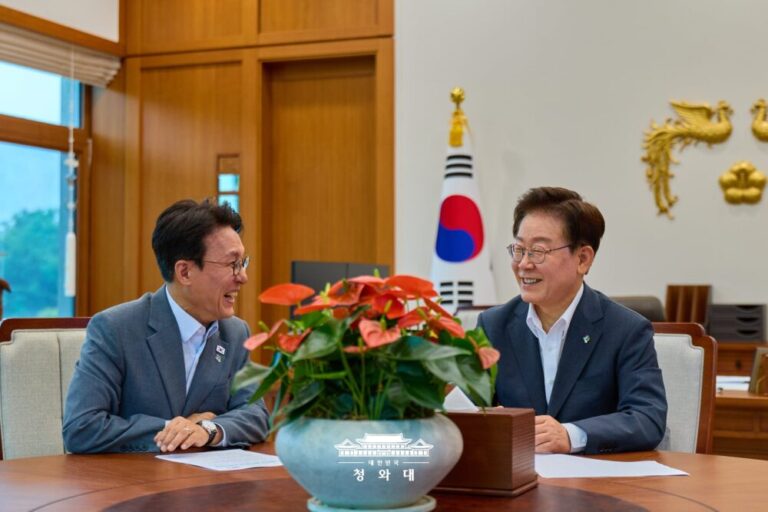
- Kim Yong-beom (Blue House Policy Director) sparked controversy again with a Facebook post. He claimed, “These are unavoidable costs of success in the process of the Korean economy leaping to a new dimension” and “not signs of crisis but the friction of a leap.”
- The logic: “not a vulnerability of the Korean economy but a paradoxical phenomenon created by success.” The argument: “As the KOSPI surged, foreign investors’ demand for foreign currency to realize capital gains pushed up the exchange rate.”
- The People Power Party criticized this as “serious distortion of reality,” calling it “typical wordplay and out-of-body rhetoric to cover up real crisis and government incompetence.”
- Heo Joon-young (Sogang University professor) said, “While I sympathize with the intent to explain the structural background of high exchange rates and some positive aspects, the emphasis seems overly focused on positive sides rather than addressing the plight of low-income groups suffering from rising exchange rates.”
- In an editorial, JoongAng Ilbo pointed out, “In a situation where structural problems of the Korean economy persist, the complacent perception of the ‘three highs’ as ‘costs of success’ is dangerously reckless.”
- Donga Ilbo also noted in an editorial, “Rising import prices due to exchange rate hikes first affect the dining tables of ordinary citizens and small business owners driving trucks,” adding, “Their lived experience is worlds apart from those benefiting from the semiconductor supercycle.”
- Related Link.
- Related Link.
- Related Link.
- Related Link.
South Korea Tops OECD Growth Rate.
- Recorded a 1.7% growth rate in Q1 (quarter-on-quarter). Hungary followed at 0.9% in second place, Switzerland at 0.8%.
- The OECD average is 0.4%.
- Related Link.
Early Summer Deluge Today.
- Jeju Island has a forecast of 250mm cumulative rainfall. A heavy rain alert remains in effect.
- Areas near Jirisan are expected to receive torrential rain at a rate of 50mm per hour. Seoul and central regions are forecasted to receive 20–80mm.
- According to the Korea Meteorological Administration, this year’s unusually high sea temperatures could lead to frequent heavy downpours.
- Related Link.
What Matters Now.
Ilbe Closure: The Moon Jae-in Government Failed.
- There was a public petition reviewed. The Korea Communications Standards Commission can only shut down a site if over 70% of its content is illegal, and it was deemed not to reach that threshold.
- Sim Young-seop (Kyunghee Cyber University Professor) pointed out, “While hate speech can be considered part of free expression, it must face legal restrictions when infringing on others’ rights.” He added, “Revisions to the Information and Communications Network Act now obligate platform operators to take autonomous measures against hate speech, and administrative regulators can impose sanctions like deletion, blocking, or fines.”
- Hong Sung-soo (Sookmyung Women’s University Professor) noted, “Laws restricting free expression must adhere to proportionality and clarity principles, which requires specifying prohibited content.” He emphasized, “Regulating evolving sarcasm that circumvents laws remains a highly challenging issue.”
- Related Link.
- Related Link.
- Related Link.
Enacting an Anti-Discrimination Law Comes First.
- Lee Chang-hyun (Professor, Kookmin University) stated, “The issue of hate speech on Ilbe is not an aberration of a specific site but a social pathology produced within the structure of Korean digital platforms,” adding, “Closing Ilbe alone won’t eliminate the Ilbe phenomenon or resolve hate speech issues.”
- Park Han-hee (Co-representative, Rainbow Action) said, “The Anti-Discrimination Law will serve as a breakwater to prevent memes and hate speech circulating online from spilling into the public sphere, by clearly defining the minimum standards of behavior our society cannot tolerate.”
- In an editorial, The Hankyoreh pointed out, “When the human rights of the most marginalized are protected, the ground for far-right forces to stand on will naturally shrink.”
- Related Link.
‘Yoon Again’ Insufficient? How About ‘Park Again’?
- Park Geun-hye (former president) is campaigning like a People Power Party election strategy chief. Her itinerary covers Chungcheong, Busan-Ulsan-Gyeongnam, and even Gangwon Province.
- A People Power Party lawmaker met by The Hankyoreh said, “Though she was impeached, isn’t she better for rallying conservatives than Jang Dong-hyuk (People Power Party leader) and ‘Yoon Again’?”
- Kim Young-ho (Democratic Party lawmaker) criticized it as “an insult to the public.”
- In an editorial, The Korea Daily wrote, “While political freedom exists, the very sight of an impeached former president meddling in elections is unsightly,” adding, “Refraining from further provocation—not misreading the public sentiment that allowed her special pardon—is the minimum courtesy owed to citizens.”
- Related Link.
- Related Link.
Kim Yong-nam’s Loan Shark Controversy.
- Kim Yong-nam (Democratic Party candidate for Pyeongtaek B) is embroiled in controversy after it was revealed he operated a loan shark company. Kim explained that he inherited the business from his brother, who originally ran it.
- Jo Seung-rae (Democratic Party Secretary-General) stated, “I believe the grounds for judging this as illegal are weak.”
- Related Link.
High Voter Turnout Equals Democratic Victory? Not Anymore.
- This time, it might be different.
- In 2018, when turnout was high, the Democratic Party swept 14 out of 17 seats. In 2022, with low turnout, the People Power Party secured 12.
- The 2030 generation was once seen as progressive but low-turnout—but their political leanings have shifted. They have the lowest presidential approval ratings and the highest rate of having no preferred party.
- Jeong Han-ul (Korean People Research Institute Director) noted, “The idea that boosting youth turnout benefits the Democratic Party is outdated.”
- Song Mi-jin (Embrain Public Opinion Research Head) added, “Whether higher turnout favors one side depends on which age group’s participation increases.”
- Related Link.
ARS Shows a Tight Race, But Does It Tell the Full Story?
- Telephone interviews still favor the Democratic Party. While some argue respondents are less candid in these calls, the high variability makes it hard to draw firm conclusions.
- In a JoongAng Ilbo-Kstat Research telephone survey, Jeong Won-o (Democratic Party Seoul mayoral candidate) led Oh Se-hoon (People Power Party Seoul mayoral candidate) 45% to 34%. (Margin of error ±3.5 percentage points at 95% confidence level.)
- In a Newsis-Ace Research ARS survey, the two candidates were nearly tied at 41.7% and 41.6%. (Margin of error ±3.1 percentage points at 95% confidence level.)
- A polling industry official interviewed by Segye Ilbo noted, “While some argue ARS surveys—which have lower response rates—are more accurate for local elections with typically low turnout, the results don’t vary much because the respondents’ leanings remain consistent. If ARS results diverge significantly from telephone surveys, it’s likely due to conservative over-sampling skewing the data.”
- Another industry veteran remarked, “After 20 years in this field, I’ve learned that in elections where opponents are framed as evil, ARS—which lets respondents feel more at ease—is the more reliable trend.”
- Related Link.
Deep Dive.
Pope’s Warning.
- Pope Leo XIV has warned of AI’s dangers. Key points from the encyclical titled “Magnifica Humanitas” (Great Humanity) include:
- First, AI can undermine human judgment by weakening creativity, discernment, and the patience required to seek truth.
- Second, AI mimics care without human bonds, leading to a confusion of empathy with genuine human connection.
- Third, AI can deepen inequality, as data, computing power, and regulatory influence are concentrated in the hands of a few.
- Fourth, AI can spread disinformation and blur the line between fact and fiction, jeopardizing democracy.
- Fifth, AI can make war easier by enabling swift lethal decisions and evading human accountability.
- Pope Leo XIV noted, “No algorithm can morally justify war.”
- The warning that “systematic sacrifices of jobs for greater profit cannot be justified” is also striking.
- Related Link.
- Related Link.
- Related Link.
Xi Jinping Lost His Temper.
- He sharply criticized Japan during a meeting with Donald Trump (U.S. President). This much was known, but the Financial Times uncovered more details.
- Xi’s reaction was visibly agitated, startling even the American staff present. Xi took issue with Japan’s 9.7% defense spending increase this year. Trump explained it was due to North Korean threats, but the mood remained tense.
- China and Japan’s defense budgets stand at $336 billion and $62 billion, respectively.
- Christopher Johnston (former White House Japan desk official) assessed, “Xi’s lack of self-awareness is astonishing.” He added, “Xi’s hardline stance is only accelerating Japan’s rise.”
- Related Link.
Trump Clings to the Abraham Accords.
- Trump wants to extricate himself from the war. On Truth Social, he mentioned Saudi Arabia, Qatar, Pakistan, Turkey, Egypt, and others, writing, “Discussing joining the Abraham Accords.”
- The Abraham Accords, aimed at normalizing relations between Israel and Arab states, were pushed since Trump’s first term but only Bahrain and the UAE have joined.
- From the Arab states’ perspective, pursuing diplomatic ties with Israel without a Palestinian state contradicts the two-state solution. In fact, Qatar and Pakistan have expressed consternation, and when silence lingered during a video conference, Trump quipped, “Can you still hear me?”
- Iran remains firm on collecting transit fees in the Strait of Hormuz.
- Trump’s position is weakening. Criticism grows that his administration has achieved nothing beyond Obama’s—failing to halt Iran’s nuclear program and allowing an even more radical regime to take power.
- Related Link.
“America Has Fallen Like Rome.”.
- Iran claims it has won.
- “In the Romans’ view, Rome was the center of the world. Iranians have shattered that illusion,” wrote Esmail Baghaei (Iranian Foreign Ministry Spokesperson) on X.
- Reuters noted, “Trump faces questions about whether he has won nearly every war but is losing strategically.”
- Related Link.
- Related Link.
Another Take.
100 Million Barrels of Oil Stalled at Hormuz.
- Even if the Strait of Hormuz opens immediately, it will take considerable time for oil shipments to recover.
- Energy infrastructure has been destroyed, and mines must be cleared. Insurance premiums are rising, and logistics costs are inevitably increasing.
- Related Link.
Jeong Cheong-rae vs. Kim Kwan-young.
- Jeong Cheong-rae (Democratic Party leader) sees the North Jeolla governor election as critical.
- Kim Kwan-young (then-North Jeolla governor) was cut from the nomination in favor of Lee Won-taek (former lawmaker), but Kim’s support as an independent candidate is surging.
- Some speculate the Lee Won-taek–Kim Kwan-young dynamic is really Jeong Cheong-rae vs. Kim Kwan-young.
- Recent polls show a razor-thin margin within the error range.
- If Kim wins, Jeong’s re-election as party leader could be in jeopardy, analysts suggest.
Smartphone Profits Poured into Semiconductors for 15 Years.
- This is Samsung Electronics’ story. Over 15 years, semiconductor (DS) division sales reached 1,047 trillion won, while mobile and appliances (DX) division sales were 2,095 trillion won—roughly double.
- Operating profits were 244 trillion won and 220 trillion won respectively.
- Facility investments were 421 trillion won and 47 trillion won.
- It’s argued that profits from semiconductors alone couldn’t have covered such facility investments.
- “Semiconductors’ growth and performance were only possible thanks to the DX division’s stable sales and profits,” some claim.
- Complaints about performance bonuses in the semiconductor division—up to 600 million won—stem from this context.
- Jokes circulate about a split between Samsung Electronics and Samsung Futures.
- Related Link.
Local Election Pamphlets Cost 30 Billion Won.
- 2022 local elections distributed 580 million pamphlets.
- This year, 7,829 candidates are running—nearly 3% more than four years ago.
- A National Government Employees’ Labor Union survey found only 11% read the pamphlets properly. 36% said they either didn’t read them or threw them away unopened.
The Five Risks of the National Growth Fund.
- 522.4 billion won worth was sold out on the first day. Only a small portion for low-income individuals remains. It’s a 150 trillion won fund investing in advanced strategic industries. 50 trillion won in direct and indirect equity investments, 50 trillion won in infrastructure investments and loans, and 50 trillion won in low-interest loans. The 600 billion won public participation fund is 0.4% of the total 150 trillion won.
- These days, companies often choose investors, and firms previously valued at 500 billion won can now see their valuations jump to 2–3 trillion won. Some argue that high valuations make it hard to set ambitious investment targets.
- The maximum tax deduction is 18 million won, but the actual refund depends on taxable income and existing deductions. The risks of the National Growth Fund are as follows:
- First, there’s a risk of principal loss.
- Second, funds are locked for five years—no mid-term redemption.
- Third, annual management and sales fees of around 1.2% apply. Taxes may still be levied even if losses occur.
- Fourth, it focuses on unlisted and growth-stage companies, requiring significant risk tolerance.
- Fifth, there’s policy risk. Success ultimately depends on government commitment, and a change in administration could reverse the plan. It’s also worth noting that government-led funds of this nature have rarely succeeded. Will the Lee Jae-myung administration be different?
- Related Link.
The Fix.
College Graduates’ Unemployment Rate Exceeds High School Graduates’ for Fourth Year.
- Unemployment rate for those with college degrees or higher is 7.4%, while for high school graduates it is 7.0%—first-quarter figures for youth aged 25–29.
- In other age groups, unemployment rates are lower for college graduates, but the late 20s cohort stands out.
- Chosun Ilbo analyzed, “While large corporations’ office jobs are shrinking due to a trend favoring experienced hires and AI expansion, high school graduates who entered the job market early have secured positions in a labor market increasingly valuing practical skills.”
- Related Link.
Zero-Care-Cost Zombie Hospitals.
- Many hospitals survive solely on government fees. The industry estimates this applies to about 20% of all nursing hospitals.
- As of 2024, the government paid 5.7371 trillion won in medical fees to 1,300 nursing hospitals. This averages 50,000–80,000 won per patient per day. Monthly, this becomes 1.5–2.4 million won, with patients bearing an additional 500,000–700,000 won.
- Typically, one caregiver in a nursing hospital tends to 5–6 patients 24/7, but hospitals without care fees sometimes handle over 20 patients. Concerns arise that this reduces care to mere formality.
- The government is considering extending health insurance benefits to cover care costs, but critics warn this could widen the gap between hospitals excluded from support and others.
- Nam Sang-yo (Inha University professor) argued, “The remaining 800 hospitals should be converted into nursing homes, etc.” He criticized, “Leaving the ‘zombie hospital’ black hole untouched while injecting funds only fuels policy side effects.”
- Related Link.
ICYMI.
Gimpo-Jeju Route Loses 1,000 Seats.
- Korean Air and Asiana Airlines allocated 13 Gimpo-Jeju route slots to low-cost carriers (LCCs) as part of their merger.
- Low-cost carriers operate smaller aircraft, so while full-service carriers lost 510,000 seats, LCCs only added 300,000.
- Daily seat supply fell from 42,342 seats last year to 40,142 this year—a 2.4% reduction.
Gwanghwamun Square Visitors Double.
- 1.9 million visitors to Gwanghwamun Square from the 13th to the 23rd—1.9 times last year’s 710,000 for the same period.
- The ‘K-pop Demon Hunters’ and BTS effect.
Shock of Triple-Leveraged Samsung+Naver ETF?
- Launching tomorrow (27th). Prices could rise up to 60% in a day—or fall by the same amount.
- The Financial Supervisory Service has urged restraint in excessive marketing, given the high investment risk. Though introduced to stabilize exchange rates by attracting retail investors, concerns persist that it may amplify stock market volatility.
- Investors must consider the negative compounding effect. If a stock falls 20% and then rises 20%, a regular product recovers to 96% (from 80%), but a leveraged product only climbs to 84% (from 60%).
Made in Korea, Chinese Cars.
- Renault Korea’s Busan plant produces Geely’s Polestar 4. It’s stamped ‘Made in Korea’ but is a Chinese car.
- KG Mobility (formerly SsangYong Motor) is also co-developing an SUV with Chinese BYD.
- Lee In-yeol (Chosun Ilbo columnist) noted, “Raising factory utilization and preserving jobs may look like a ‘win-win’ for now, but the real winners are Chinese companies collecting technology royalties and controlling supply chains.”
- Related Link.
Uncertified Autopilot Devices for a Quarter of Tesla FSD’s Price.
- Cars with uncertified auxiliary devices are increasing. For about 2 million won, one can install Comma AI and illegally modify a vehicle.
- Tesla FSD (Full Self-Driving) costs 9 million won, so this is roughly a quarter of the price.
- The Ministry of Land, Infrastructure and Transport views this as a violation of the Automobile Management Act.
- According to the Korea Transportation Safety Authority, there were 81 accidents involving driver-assist functions last year.
- The Donga Ilbo warned, “If an accident occurs, one could face massive legal and financial liability.”
- Kwon Yong-joo (Kookmin University professor) said, “Insurers are likely to reject insurance claims.”
- Related Link.
Worth Reading.
Caffeine Depression and the Rise of Setlog+BeReal.
- KakaoStory, Facebook, and Instagram together are called “Caffeine.” Caffeine depression stems from the relative deprivation created by social media.
- The rise of new social media like Setlog and BeReal can also be understood in this context.
- Setlog allows users to share 2-second videos every hour with 12 people. BeReal sends a daily alarm, requiring users to upload a video within 2 minutes. Both are closed platforms with no “like” counts.
- Lee Young-tae (The Korea Times columnist) assessed, “Feeling relief and solidarity only after witnessing the relentlessly ordinary daily lives of others—that is the honest sentiment of young people struggling through harsh times.”
- Related Link.
Why the Starbucks Incident Cannot Be Overlooked.
- Kim Min-ah (Kyunghyang Shinmun columnist) warned, “If this incident is not handled strictly according to common historical awareness, it could result in legitimizing far-right public discourse.”
- “Failure to clearly sanction forces crossing red lines may lead us to face a political and social abyss (無底坑; bottomless pit),” she cautioned. Kim emphasized, “Those who insult the core values of the community must face appropriate consequences.”